
Pile Driver Accidents: 7 Shocking Causes That Claim Lives Every Year

Table of Contents
Pile Driver Accidents: 7 Shocking Causes Every Site Worker Needs to Know
Pile driving is one of the most dangerous jobs in construction. The equipment is massive. The forces are extreme. The environment is unpredictable. And when something goes wrong, the consequences are often fatal.
Every year, workers lose their lives on pile driving sites. Some are crushed. Some are electrocuted. Some are struck by flying debris. Some are buried under collapsing equipment. These are not rare events. They happen regularly across construction sites worldwide.
The sad truth is that most pile driver accidents are completely preventable. A few seconds of carelessness. A skipped safety check. A moment of fatigue. That’s all it takes for a routine job to turn into a deadly scene.
Understanding the real causes of pile driver accidents is the first step toward preventing them. This article examines 7 shocking causes that claim lives every year. Each cause has been documented in actual workplace incidents. Each one is avoidable with proper precautions.
Pile driver accidents don’t happen randomly. They follow patterns. They occur in predictable ways. Learning these patterns saves lives. Here are 7 shocking causes of pile driver accidents that every site worker needs to know.
1. Hydraulic Hose Bursts
Hydraulic systems power pile drivers. They deliver enormous force through high-pressure fluid. Hoses carry that fluid at pressures exceeding 3,000 PSI. When a hose bursts, the results are catastrophic.
Hot hydraulic fluid sprays at high velocity. It penetrates skin instantly. It causes severe burns, tissue damage, and blindness. Workers standing nearby get hit before they can react. The spray covers large areas. Multiple workers get injured in a single incident.
Pile driver accidents from hose bursts happen frequently on sites that skip inspections. Worn hoses show warning signs. Cracks. Bulges. Soft spots. Heat damage. These signs get ignored. Then the hose bursts during operation.
The machine also jerks violently when pressure releases suddenly. Workers lose balance. They fall from heights. They get pinned against structures. The combination of fluid spray and machine movement turns a hose burst into a multiple-injury event.
Prevention requires daily hose inspections. Every hose must be checked before starting work. Any worn hose must be replaced immediately. Protective covers and shields should be installed on all high-pressure lines. Workers must stay clear of hose paths during operation.
Pile driver accidents involving hydraulics are among the most severe. They cause permanent disabilities. They cause deaths. They are entirely preventable with basic maintenance and awareness.
2. Overturns and Tip-Overs
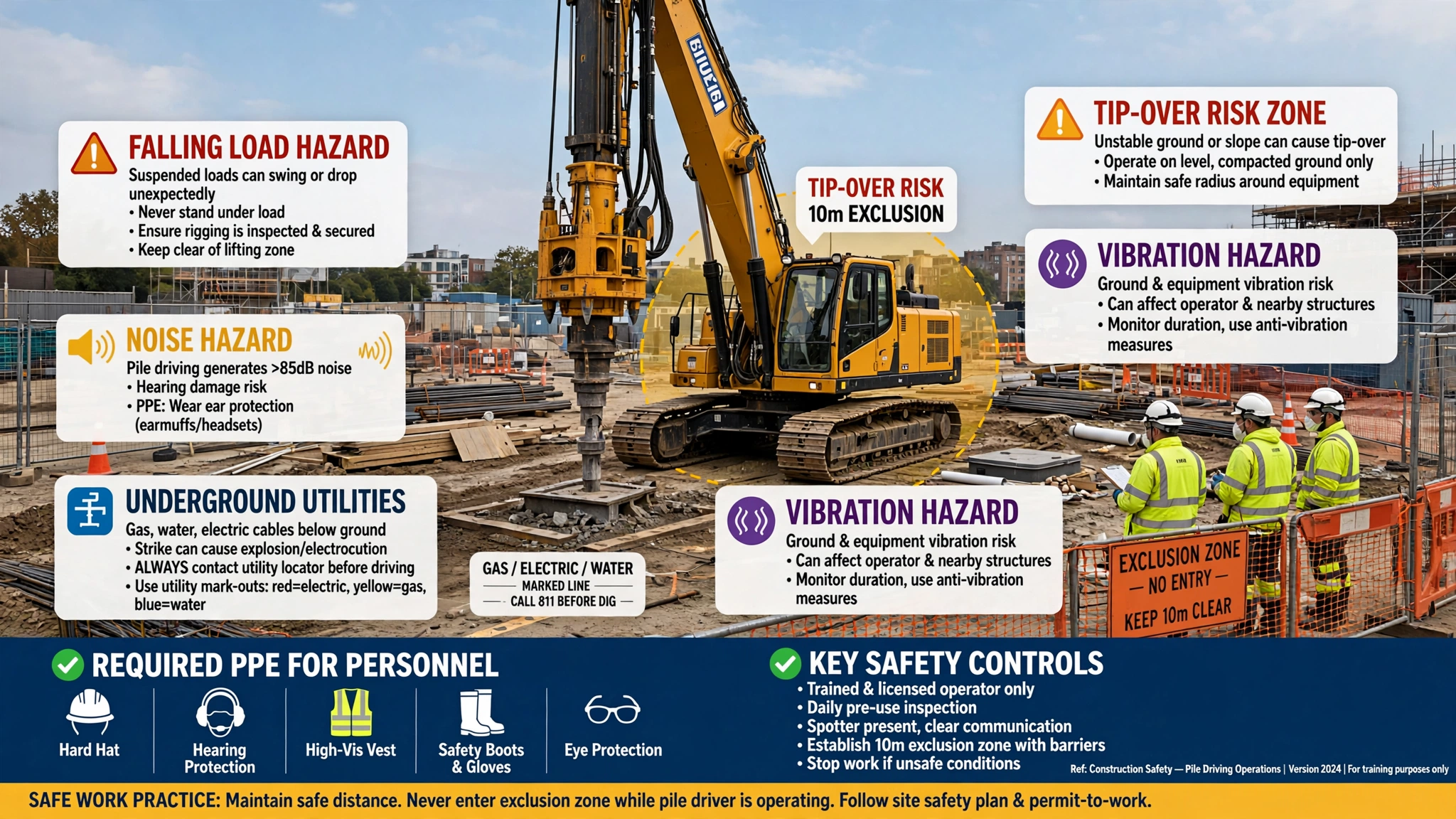
Pile drivers are top-heavy machines. The hammer sits high on the leader. The base is relatively narrow. The center of gravity is high. Any instability in the ground or positioning can cause a tip-over.
An overturning pile driver is a terrifying sight. Thousands of pounds of steel crash down in seconds. Workers nearby have no time to escape. They get crushed under the machine. They get pinned against other equipment. They fall from the platform as the machine tips.
Ground conditions are the primary cause of pile driver accidents involving tip-overs. Soft soil, uneven terrain, and slopes all increase the risk. Operators sometimes position machines on ground that looks solid but isn’t. Hidden voids, clay layers, or water-saturated soil give way under the machine’s weight.
Vibration from hammering accelerates the process. Each strike shakes the ground. The machine settles. It tilts. The operator tries to correct. But it’s already too late. The overturn happens in a split second.
Prevention starts with thorough site assessment. Ground conditions must be tested before positioning any pile driver. Outriggers and stabilizers must be fully extended on every job. The machine must be perfectly level before any operation begins.
Pile driver accidents from overturns also happen when machines are moved improperly. Moving with the leader raised increases the risk. Swinging the hammer without proper counterweight causes imbalance. Simple precautions prevent these deadly incidents.
3. Electrocution from Overhead Power Lines
This cause of pile driver accidents is the most instantly fatal. Overhead power lines are everywhere. Pile drivers are tall. The combination is lethal.
The leader extends high into the air. The hammer swings from side to side. The machine rotates during positioning. Any of these movements can bring the pile driver into contact with a power line. The operator gets electrocuted instantly. Anyone touching the machine gets electrocuted too.
High-voltage lines are the most dangerous. But even low-voltage lines can kill. The human body cannot handle electrical current at any significant voltage. Death occurs within seconds.
Pile driver accidents involving power lines often happen because the operator didn’t see the line. Trees hide them. Sunlight obscures them. The operator focuses on the ground and forgets to look up. The spotter fails to warn them. The machine swings into the line without warning.
Some accidents happen when operators try to move power lines out of the way. They use the machine to push lines aside. The lines break or the machine makes contact. Fatal electrocution follows.
Prevention requires strict adherence to clearance distances. At least 20 feet of clearance must be maintained from all power lines. If that distance cannot be achieved, the utility company must de-energize the lines. Spotters must be assigned to watch the leader during all movements.
Pile driver accidents from electrocution are 100 percent preventable. No job is worth this risk.
4. Struck-by Debris and Flying Objects
Pile driving creates flying debris. Steel fragments. Concrete chunks. Rocks. Tools. Any of these become projectiles during operation. They strike workers with lethal force.
Concrete pile driving is especially dangerous. Pre-stressed concrete can shatter. Sharp fragments fly outward at high speed. They cut. They penetrate. They kill. Workers standing within the impact zone get hit before they can duck.
Steel piles also create debris. Rust flakes off. Splinters of metal break loose. Hammer parts can detach. The violence of pile driving turns ordinary materials into deadly missiles.
Pile driver accidents from debris strikes are common on sites without proper safety perimeters. Workers stand too close. They watch the operation instead of staying clear. The debris doesn’t discriminate. It hits anyone in its path.
Some debris strikes happen because workers are on the ground near the pile. They may be checking alignment or guiding the pile. They think they are safe because they are off to the side. But debris doesn’t always fly straight. It ricochets. It changes direction. It finds them.
Prevention requires strict exclusion zones. Nobody should be within 50 feet of the pile driver during operation. 100 feet is safer. Protective screens and shields should be used whenever possible. Hard hats and face shields must be worn at all times.
Pile driver accidents involving debris are among the most violent. They cause severe head trauma. They cause blindness. They cause death. The physical impact alone kills, even without penetration.
5. Crushing and Pinch Point Injuries
Pile drivers have hundreds of moving parts. Gears mesh. Cylinders extend. Hinges close. Steel meets steel. And between all those moving parts are pinch points.
Hands get caught. Arms get pulled in. Feet get trapped. Legs get crushed. The machine doesn’t stop. It keeps moving. The worker is caught until someone stops the machine. By then, the damage is done.
Pile driver accidents from pinch points happen when workers get complacent. They’ve done the job a hundred times. They think they know exactly where the danger spots are. They stop paying attention. Their hand slips. Their foot moves. And they’re caught.
Cylinder extensions are especially dangerous. Hydraulic cylinders extend without warning. Pins shift. Arm movements sweep across spaces that seemed safe. Workers standing in those spaces get crushed between moving parts.
Maintenance and repair work cause many pinch point accidents. Workers reach into confined spaces. They try to fix something quickly. They don’t lock out the machine. The machine starts unexpectedly. The worker is caught.
Prevention requires strict lockout-tagout procedures. The machine must be completely shut down before any hands go near moving parts. The controls must be locked. The worker must have their own lock on the machine.
Pile driver accidents from pinch points are brutal. They crush bones. They sever limbs. They cause amputations. They cause death. Every pinch point is known. Every one is documented. There is no excuse for ignoring them.
6. Falls from Heights
Working on a pile driver means working at height. The operator sits high up. Workers climb the leader. They walk on platforms. They access confined spaces. And when they fall, they fall a long way.
Falls from pile drivers are often fatal. The height alone causes severe injury. Landing on steel or concrete compounds the damage. Workers who survive falls from height rarely walk again without assistance.
Pile driver accidents involving falls happen when safety equipment isn’t used. Harnesses are available. Lines are available. But workers don’t use them. Maybe they are in a hurry. Maybe they think they won’t fall. But they do fall. And they can’t stop it.
Slippery surfaces cause falls. Rain makes steel slippery. Grease accumulates. Mud coats the steps. A simple misstep becomes a falling incident. The worker can’t regain their footing. They go over the edge.
Some falls happen during climbing. Ladders are steep. Access is difficult. Workers carry tools with them. Their hands are full. They can’t hold the ladder properly. They slip.
Prevention requires mandatory fall protection. Harnesses must be worn. Lanyards must be attached. Guardrails must be installed on all platforms. Access ladders must have handrails. All workers must be trained in proper climbing techniques.
Pile driver accidents from falls are completely preventable. A few minutes of safety preparation prevents a lifetime of disability.
7. Fatigue and Human Error
This is the underlying cause of many pile driver accidents. Fatigue makes workers slow. Fatigue makes them miss warning signs. Fatigue makes them forget procedures. And fatigue leads to fatal mistakes.
Workers on pile driving jobs often work long hours. Deadlines are tight. Crews are small. The pressure is intense. They push through exhaustion. They tell themselves they are fine. They aren’t fine. They are dangerous.
Pile driver accidents caused by fatigue happen in predictable ways. A tired operator forgets to extend outriggers. The machine tips over. A tired worker forgets to check the power lines. The leader swings into them. A tired worker misses the worn hose. It bursts.
Fatigue also causes decision-making failures. Tired workers take shortcuts. They skip steps. They assume things will be fine. They’ve made the same assumptions a hundred times before. But this time, it’s not fine. Something goes wrong. Someone gets hurt.
Human error from fatigue is not just about physical mistakes. It’s about judgment. It’s about awareness. A fresh worker sees the danger. A tired worker doesn’t. They just want to finish the job and go home.
Prevention requires strict work hour limits. 8-hour shifts are safe. 10-hour shifts are manageable. 12-hour shifts are risky. Anything beyond that is unacceptable. Breaks must be taken. Hydration must be maintained. Sleep must be prioritized.
Pile driver accidents from fatigue are unnecessary tragedies. They take lives. They destroy families. They cost companies millions. And they could have been prevented with proper scheduling and rest periods.
Why These Accidents Continue to Happen
Despite all the training and regulations, pile driver accidents continue to occur. The reasons are simple.
Companies cut corners to save time. They skip safety checks because they are behind schedule. They push workers to work faster and longer. They ignore warning signs because stopping costs money.
Workers accept unsafe conditions because they need the job. They don’t speak up. They don’t refuse unsafe work. They hope nothing goes wrong. Sometimes they get lucky. Sometimes they don’t.
Regulations exist. Training exists. Safety equipment exists. But none of it works if people don’t use it.
8 Common Safety Failures
- 1. Not inspecting hydraulic hoses daily.
- 2. Positioning on untested ground.
- 3. Ignoring overhead power line clearance.
- 4. Failing to enforce debris exclusion zones.
- 5. Skipping lockout-tagout during maintenance.
- 6. Not using fall protection equipment.
- 7. Allowing extended shifts without breaks.
- 8. Accepting unsafe work conditions.
Final Word
Pile driver accidents don’t have to happen. Every cause discussed here is preventable. Every death is avoidable. Every injury is unnecessary.
Hydraulic bursts. Overturns. Electrocution. Debris strikes. Pinch points. Falls. Fatigue. These are not random events. They are predictable failures. They happen because someone skipped a step. Someone ignored a warning. Someone decided safety wasn’t worth the time.
Every worker on a pile driver site must understand these hazards. Every supervisor must enforce safety procedures. Every company must prioritize safety over speed.
The numbers are clear. Pile driver accidents claim lives every year. They don’t need to claim any more.
Stop cutting corners. Follow the procedures. Use the equipment. Take the breaks. Stay alert. Stay alive.